Selected work / Project case study
Ball on a Plate
An ETH Zürich control systems project using RRT, RRT*, and RRT*-Smart motion planning to steer a ball on a tilting plate, with interactive CAD and simulation.
Images & interactive demos
Simulation replay · loopingSoft Actor-Critic · 20-second rollout
Overview
Ball on a Plate is a control system project developed at ETH Zurich. A free ball rests on a tiltable plate; by commanding the plate angles you shape the ball's acceleration and steer it toward targets or through obstacle layouts. My focus was motion planning: RRT, RRT*, and RRT*-Smart paths that a lower-level controller can track on the real hardware.
System Overview
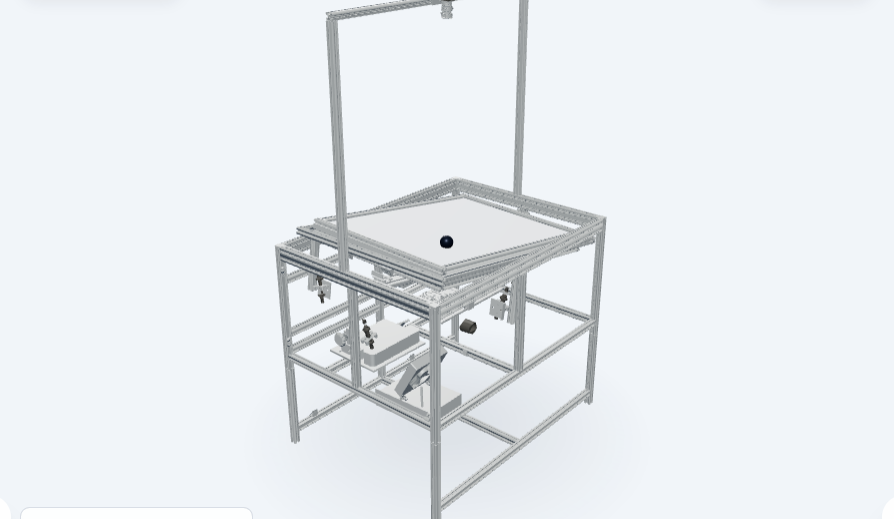
The plant is a two-axis gimballed plate. Two motors set the pitch and roll; an overhead camera measures the ball position; a real-time loop closes the gap between desired waypoints and the physical ball. Tilting the plate couples gravity into planar acceleration, so even small angle errors compound quickly, which is why planning must respect ball radius, clearance, and reachable tilt limits.
Test it yourself
Move your mouse over the CAD machine to tilt the plate in X and Y and watch the ball accelerate downhill under the same gravity coupling a planner and controller have to fight on the real system.
Move the mouse over the machine. Tilt it and watch the ball move freely.±10° · free roll · rim bounce
Path Planning Implementation
I implemented three path planning algorithms for this project: RRT, RRT*, and RRT*-Smart. The carousel tree visualization shows the planned path with grey regions around the trajectory for the physical ball thickness and safety margin.
Implemented Algorithms
Rapidly-Exploring Random Tree (RRT)Classic
I implemented the classic RRT algorithm for motion planning in cluttered environments. RRT incrementally grows a tree of collision-free states by sampling random points in the configuration space and connecting them to the nearest node if the straight-line path is obstacle-free. Because it aggressively explores large, unknown regions, it is very good at quickly finding a feasible path from start to goal – but that first path is usually quite suboptimal and jagged.
RRT*: Asymptotically Optimal RRTOptimized
To improve path quality, I implemented RRT*, which extends RRT with a cost-aware rewiring step. As the tree grows, each new node not only connects to the nearest state, but also chooses the parent that yields the lowest cost-to-come, and then "rewires" nearby nodes through this new state if it shortens their path. Over time, the tree converges to an asymptotically optimal solution: the path becomes shorter and smoother as more samples are added, at the cost of higher computation per iteration.
RRT*-Smart: Biased, Beacon-Guided OptimizationAdvanced
Finally, I implemented RRT*-Smart, which accelerates RRT*'s convergence by combining online path smoothing with intelligent sampling. Once a first path is found, the algorithm optimizes the path by removing redundant waypoints and straightening segments, extracts "beacon" nodes along this optimized path, and biases future samples to lie in a region around these beacons, while still mixing in uniform samples for global exploration. This focused sampling around a continually re-optimized path lets RRT*-Smart reach high-quality paths much faster than plain RRT*, especially in cluttered environments.
Technical Implementation
The entire project, including all RRT algorithm implementations, is written in Python. The grey regions in the path visualization represent the physical ball thickness, ensuring that the planned trajectories account for the actual ball dimensions and provide safe navigation margins. Another team member implemented a controller that tracks the planned path.
Skills Demonstrated
Project Context
This project was developed as part of coursework at ETH Zurich, demonstrating advanced understanding of path planning algorithms, control theory, and their practical application in robotics systems.